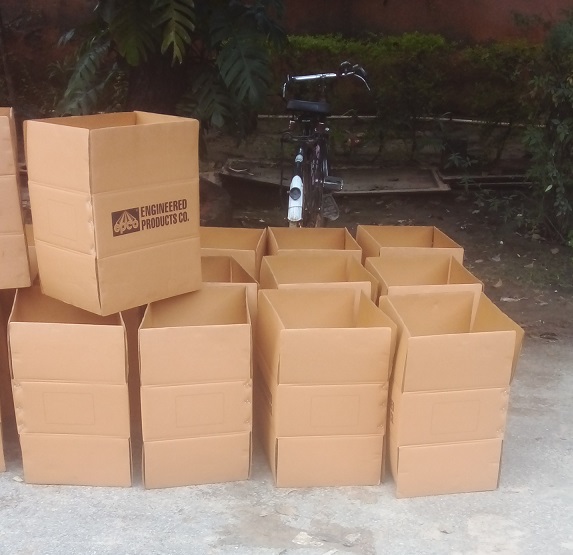
Corrugated box and cardboard box packaging

A corrugated box is made by compressing the Kraft paper containerboard in the shape of S arch and then sandwiching it between the linear board with the help of the adhesive. The output is a corrugated sheet and the box made from the sheet is a corrugated box. A corrugated box besides being lightweight is also beneficial in more ways. It is sturdier, robust, can be made of big or small sizes, and is durable while being reusable.

Some of the salient benefits of the corrugated box are,

1.      Corrugated boxes are much stronger than a cardboard box

2.      These boxes can be recycled and reused as they are made of biodegradable material

3.      Corrugated box offers better flexibility and are cost-effective

4.      Sustainability of corrugated box that are cost-efficient

5.      Corrugated boxes are customizable and provide a branding option.

6.      The Corrugated box helps to protect the product from moisture and bacteria.

Corrugated boxes are often mistaken for cardboard box. In reality, both the boxes are different and made using other processes. Cardboard boxes are made from a single layer of sheet and from heavy paper pulp. This cardboard box is used as a packaging material in the form of cereal boxes, greeting boxes, food products, etc. So, the difference between a corrugated box and a cardboard box is the unique process through which these are built. The raw material for building both products is the same. Construction is also not the same, corrugated box are made of three liners of a corrugated sheet. One of the liner board sheets is sandwiched between the other two increasing the durability of the box. While a cardboard box is made of a single sheet of heavy paper pulp, it is low in durability as compared to corrugated boxes.

Many different corrugated boxes can be made from use of above processes. Some of these are 3 ply, 5 ply, 7 ply and 9 ply corrugated box, die cut corrugated box, custom printed corrugated box, white boxes, and multi-depth box. There are also blister packages, display POS packaging, vacuum packaging box, and many more. Different types of flute paper are utilized in manufacturing corrugated boxes. These are

Type A Flute

Corrugated box containing type A flute has excellent compression, cushioning, and good stacking strength. Mainly used to pack fragile items. The corrugated box has 36 flute per square foot with a thickness of ¼.

Type B Flute

The box made from type B flute are excellent in resisting puncture and flat crush. This type of flute is used for inner packing and displays. It has 46 flutes per foot with a thickness of 1/8.

Type C Flute

This type of C flute paper is used in building and construction shipping boxes, food products and for securing fragile items like glass or furniture. It has compression properties and crush resistance.

Type E Flute

Type E based flute paper and produced corrugated boxes are made for consumer goods, displays, ballot box and food products. It has a very thin construction and thus it consumes less storage space. It contains 90 flutes per foot with a thickness of 1/16.

Type F Flute

The box containing F Flute type paper is lightweight and extra thin as compared to other flutes. It is an excellent choice for printing purposes, thus it is used for packaging of consumer goods like jewelry, shoes, etc. It is made from 124 flutes per foot and with thickness of 1/32.


Corrugated box benefits to packaging


             Packaging products are a requirement for plenty of firms. These products provide a safety cover for most items from pilfering or breaking during movement till reaching the final customer place or hands. Packaging from plastics, cardboard, and newly discovered corrugated boxes. Special emphasis on these boxes deserves attention for their quality, utility, and value for money. 

Paper made from wood pulp is central to the production capacity determined by the organization. A capacity of 100 metric tonnes per month is culpable and ordinarily assessed. It is easier with using processes in manufacturing while using them initially is important for processing corrugated boxes. These processes require paper, kraft paper, and flute as starting ingredients for corrugated boxes. This is called the kraft process discovered in 1884, after the scientist Carl F. Dahl developed it for pulping wood chips into a strong paper that resists tearing, splitting, and bursting.

Corrugated boxes are made from cardboard and kraft paper. Both these are not clearly available in the right pricing these days. Doubling of prices and unrest had started in the past two years. Nowadays urban requirements for new products have enlivened and enlarged the demand for packaging. Thus, these days the demand and supply framework at the factor markets has opened dialogues and discussions about changing distribution channels and sales growth.

Raw paper produced from wood and wood pulp is dearer as the availability from felling or cutting down trees hampers ecosystems and wild habitats. Wild areas full of trees that can be felled are down in numbers and leading to the additional apprehension that supplies might be lower. The recycled paper quality needed could be low for manufacturing corrugated boxes. Thereby the avenues for bringing raw production of paper from industries are getting lower by the day. If there was a possibility of recycled paper quality being standardized for producing kraft paper then this is one of the ways demand is met easier. Also corrugated box quality depends on moisture, weight or grammage, cobb value, and a few other tests for kraft paper or corrugated liner.

As the changes or market moves require industries to focus on cardboard and paper rather than plastics, it is ever more a cumulating measure by the government to curtail unnecessary moves in the industry. Maintaining all known wreckages to low levels and errors to a minimum is a cause not many would identify in the wake of this trouble. This adds to the unlikely approach from associations and industry that the raw supply of paper at higher prices is a seasonal issue and not permanent. The requirement of coal as input for power and electricity in the manufacture of recycled paper and kraft paper is high priced at Rs 5000 per tonne to Rs 15000 per tonne.


Indian market for packaging


Packaging in the Indian subcontinent has been a little-known industry and has grown by leaps in past decades. Corrugated liners, plain paper, and kraft paper are for packaging as assets are gainful in the long run. Packaging has newer forms of products like plastics, polypropylene (PE), PVC, cartons, corrugated boxes, pouches, and thin film sheets for various packaging.

Packaging has numerous forms flexible packaging, food packaging, plastic packaging, rigid packaging, corrugated packaging, and more. From research reports, it is insight that the food industry holds the largest share in the packaging industry. Online food ordering witnessed high growth in lockdown and there was a sudden spurt in online food ordering. Various dairy manufacturers brought about milk carton products useful in packaging liquids. Corrugated boxes, and paper products significantly transported food, medicines, medical equipment during 2021.

Value of paper and paper products exported in India 2021

Packaging products are on the rise in delivery even for further products than food, pharmaceuticals, electronics, clothing, cosmetics, and more. There is a rise in packaging products being transported to new countries that were not so before. With the rise in demand for packaging, there are also queries as to how many dominant players are in this industry. As can be seen from the figure the Indian packaging market is competitive with few dominant players.


Packaging industry


The logistics or supply freight industry has a far reach and scale of operations in a country. Suppliers are level in bringing additional value unexplored earlier. Timely deliveries, scheduled distributions, lagging support, change of transport, vehicle expenses, and more are essential functions of supply for manufacturers and businesses using packaging. Inward and outward supplies are relevant for a segregated market. Well-developed markets use better inward supplies of paper, while outward supplies from packaging to business manufacturers use custom freight and delivery.

Delivering packaging products to manufacturers retains the most necessary and essential activities supporting distribution. Sales and marketing are brought together with suppliers providing timely packaging from manufacturers to businesses. Packaging products retain B2B as the main focus of their commerce in the industry.


Corrugated box and packaging

              Packaging products like corrugated boxes, packaging boxes, blister packaging, mono cartons, HIPS trays, and much more are a class output for a number of products in industries of medicines, electronics, parts, automobiles, and more. Distribution of these products to manufacturers saves effort and time in covering products for safety and security up to the buyer or customer place, and address.

              Corrugated boxes come in a very plenty of sizes, shapes, and weights. They are 3-ply, 5-ply, 7-ply, and 9-ply corrugated boxes. As regards their formation with paper, flute paper, adhesives, and stitching they are categorized into the ply-specific box. Length and depth with width are also important for a packaging box as per the use or utility to which these are to be sent. Cosmetics and medicines would like a small box, much like electronics. The quality of paper used in the production of the corrugated box like grammage, moisture levels, and sturdiness also impacts the quality of the overall corrugated box produced. The utility, quality, and sturdiness of a corrugated box are built from the above essential ones. The quality of machines, oil, adhesives, and other tasks is also important.

              If you want you can read more about corrugated boxes, the packaging industry, and more, following can be read. You can post comments, review for us on Google Plus, share your insight, and like us on Facebook. 

vividhpack.com

Packaging Industry in India - JustPaste.it

https://www.linkedin.com/company/vividhpackagingindustries/

Packaging Industry In India And Consumption - Small Business - OtherArticles.com

www.facebook.com/Vividhpack


Machinery at work

                  A lot of emphasis is placed on machine designs, automation controls, working stability, and the industry of corrugated boxes, and packaging box-based manufacturing.

               There are gains in production and productivity when processes including moisture levels of paper, weightage, kraft paper, cardboard, liner, and pulp necessarily assessed for producing an effective corrugated packaging box. 

                  Below you can observe machines doing their work like rolling, cutting, forming, and other tasks as scheduled by a supervisor, the automation controls, adequate input paper, machine oil, coal, and all inputs are present and can augment production further.


Video showing printed logo sheet being placed on the corrugated 

Machines at work finishing tasks, completing corrugated box


Printed logo placed on the corrugated 


                                          vividhpack.com


New changes in industry


        In the past decade industries that have come up in much more ways than one are information technology, railways, roadways, airlines, power, defense, social media, construction, and more. Of these packaging, is a big behemoth as the statistics suggest and because of support it was not expected to become a bigger industry. It is in huge demand status because of urban consumerism, changing products, food processing, tamper-proof packaging, and better ways to distribute new innovative products.

Apart from packaging using plastics, paper, and cardboard, the use of machines, automation, and tagging, is in big requirement. Very less paper is available and after corona pandemic production is starting up a bit later than usual. New innovations are inline like pouches, tags for geolocation, plastics like polypropylene, PVC, flexible packaging, blister, and vacuum packaging.

Searches: packaging, packaging box, corrugated box, blister packaging, display packaging

vividhpack.com

Planning entrepreneurship


Customers require easy-to-handle packaging with their purchase, which is stable, durable, and lightweight. Their preferences for packaged foods, products, and services have been changing in the past decade. Packaging in the past had been nothing but a covering with paper, material, or wood. As far as the automation of machines and manufacturing progressed, a number of innovations and as much more came up. A lot of machines exist today for producing 3-ply, 5-ply, 7-ply, and 9-ply corrugated boxes. 


Recycled or kraft paper is best available for producing these boxes using adhesives, oils, and coal. Most of the LDC or growing economies used plants or green leaves to cover goods and products earlier, and now they have boxes produced by providers. Such boxes come in dimensions of big to small length, width, and thickness. Quality of paper with less moisture and appropriate weight helps in box sturdiness and use from procuring all raw input. 


One of the breakthroughs for industries on the watch is whether the leading purposes of automation and machining in factories would be able to be administered easier in gestation and supply support issues like innovating machines, cost-effective measures of input control, project planning, budgeting, and resource mobilization. With change comes a lot of problems from structuring to streamlining operations. By the intrigue of such and more changes, the popular means is a delay in production, less workforce, and fewer machine costs. Changing preference for food packaged in containers, bins, bottles, and beverages has made a small enough direction for product variety and support for using machines to produce better boxes, bins, trays, POS, etc. It has added new ways of providing delight to customers in long term. Preparation of meals takes time. In double-income households, where women are preoccupied with activities outside of the home, meals that come in the easy-to-open package are extremely popular.


The trend of consuming more (a reflection of rising incomes) is demand that drives inducing products in ready-to-go and prolonged shelf-life packages to higher volume purchases. Initiatives of capital funding from the government and GST are on the risk side of the industry. In the process of planning for future production, there is to be procurement control in an unregulated market and preferably budgeted capital expenditure for numerous old businesses. It would take many months before a risk-budgeted plan comes through for easing tough norms on production, procuring, and distribution.


Producing material, and procuring is on the latest view in times of economic crises and pandemics. The woes might increase or decrease as the suppliers raise prices for factor inputs. In the past two years, the problems increased after war situations changed the external markets and responded by increasing or decreasing demand and supply to the newer nation. Thus, packaging has been at the front of industrial development and unshackling also thereby impeding bottleneck hassles. As one waits for the workforce to gain personnel support in managing unexpected changes it would also be a big assurance that the war crisis is over as soon as it could be possible.

Paper used for manufacturing packaging products

Paper and paper processing is one of the important changes in the past 10 years in the economy from an onlooker of the packaging industry. The bureaucracy in the stock and share bourses has lessened with ease of business and a focal apex in this industry boom is one of the causative latest changes. From people moving from and to overseas markets for paper, the newsroom is abuzz with new market breakthroughs much needed today.

Summits have come together at prodigal importance that the high identity of Indian Industry has come to pass. Though it could have been seen in a lesser effortless way by low and middle management. Personnel management already formed a ranking, that many visualized for the leader summits. Some of the leader summits have talked about this, though leaders cannot underestimate it.

Packaging includes processing, blister, corrugated boxes, and a significant approach in producing from these raw materials, especially wood pulp. It is a process for producing paper from wood that determines the quality of paper for corrugated boxes. Various organizations are now wanting to produce better paper rather than just recycle it. Many youths would like to start up their industry here. As the changes or market moves require industries to focus on cardboard and paper rather than plastics, it is ever more a cumulating measure by the government to curtail unnecessary moves in the industry. Maintaining all known wreckages to low levels and errors to a minimum is a cause not many would identify in the wake of this trouble. The requirement of coal as input for power and electricity in the manufacture of recycled paper and kraft paper is high priced at Rs 5000 per tonne to Rs 25000 per tonne.

Indian packaging industry has been a forerunner of the rising Indian diaspora. In the last ten years, it has become a big industry with rising CAGR, consumers, and generated lot of revenue. A lot of emphasis has been brought about in demographic changes (disposable incomes rising, demand increasing) impacting industry. It is in many ways an important part of the process of distributing final goods to customers. All major and small organizations of the world want their products to reach customers being safe and unbroken in every way. The few associations in the industry are;

·        Indian Aerosol Science and Technology Association

·        Aerosols Promotion Council

·        Eastern India Corrugated Box Manufacturers' Association (EICMA)

·        Federation of Corrugated Box Manufacturers of India

·        Indian Corrugated Case Manufacturers' Association (ICCMA)

Indian Flexible Packaging & Folding Carton Manufacturers Association (IFCA) (Formerly known as Paper Film & Foil Converters Association) and Packaging Industry Association of India (PIAI) are also organizations providing all suppliers important directives and regulations.

This Industry in the past 10 years analysis for sales and finance sections shows higher than current average in CAGR. The Market size was valued at US$ 81.07 Bn in 2021, The future total revenue growth could be 26.1% from 2021 to 2027, reaching nearly US$ 325.95 Bn.

Upcoming materials introduced in the Indian segment are corrugated boxes and pvc. These boxes are leading materials used in packing and transporting. Cardboard is commonly misused when referring ta o a corrugated box. The correct term is “corrugated fiberbyard carton.” These are really used for light products, cereal or board games. The fiberboard boxes are utilized in retail, shipping cartons, product displays and many other applications. They need a light and sturdy material.

Fiberboard includes a linerboard and a heavy paper medium. Linerboard is flat, outer surface that attaches to the medium. The medium is the wavy, fluted paper between these liners. Both papers are made of a special heavy paper called containerboard. A board made thus, has strength depending on the various liner board and medium combinations. Thus, many boxes type is defined as Slotted Boxes, Telescope Boxes, Folders, Rigid (or Bliss) Boxes, Self-Erecting Boxes, and Interior Forms. Custom made corrugated boxes are also available. 

vividhpack.quora.com

vividhpack


Paper as input used in packaging


Not recently the country became one of the few privileged to have achieved the G-20 nations presidency. It is a proud moment for country people when they had their goals aligned with the growth in the economy. Many hurdles like corona, taxation of GST, easier norms for business, capital initiatives in funding from the government, packaging initiatives particularly and have paved the development in many ways. Interstate funding, department sufficiency on quality, private debt burden, deficits in government at the center, sustainability and stability with public-private partnerships in health, housing, natural disasters, food, and many segments has been the critical trepid in the past decade. A single reason why Indian bourses are in this wave of developing forces is the economic resurgence of many sectors like packaging, recycling, logistics, electricity, urbanization, and assessing communal divide as governing in tiered development. Across challenges from different languages, ages, gender, and classes these related designs interweaved in a specific change marked with numerous pandemonic days. Gasoline prices, exchange rate stability, interest loan rate ups and downs, and impacts on suppliers in markets eased funding, debt management, and export-import worries of duties, licenses, and norms. The government focussed on duty structure, licensing at peak rate, and various measures for lower to subsistence-class people for banking, insurance, and health programs.

Changing relations for suppliers in edgy market

Suppliers and manufacturers in the market stood to gain from political stability at the center, funding and associate progressive support in guidelines and licensing for Startup India and Digital India movement as a push to e-commerce, green fuelling directives, and plenty of positive developments in surveys for data of quality, also increasing population return filing their tax from public and private institutions.  A new inflation targeting framework for bigger energy subsidy reforms, fiscal consolidation, higher marked compliant public expenditure and a stable balance of payment situation. Recent reforms helped Indian business environment from easier inflows of foreign direct investment (FDI), and improved credit. The positive impulse expected from India’s novel GST system rated by credit agencies as more complex than comparable systems in other countries, can improve domestic flow of goods and services, and sustainably enhance growth.

National changes for suppliers

Small suppliers of paper, and coal, can now supplement their output and business stability from effective demand of manufacturers at using FDI, credit funding from norms compliance increasing at forward levels of market business, reaching new customers from better e-commerce, and gaining buyer-perfect information for many. Recent news of suppliers of paper exporting to china surfaced fuelling shortage of high prices in season, and union improbable terms in manufacturing blocking flow in packaging. Other developments apart from the presidentship of the G20 nations group are that International Monetary Fund (IMF), says India has passed United Kingdom (UK) to become the fifth-largest economy in the world at the end of 2021. Corporate Affairs Ministry (MCA) relaxes the paid-up capital threshold for small companies, facilitating further Ease of Doing Business and decreasing finance burden for such companies. From the revised definition, the threshold for paid-up capital for small companies would be “not exceeding ₹4 crores” and the turnover threshold is “not exceeding ₹40 crores”.

Paper industry scalability of production

Unregulated factor market in India with 700 manufacturers in packaging alone, suppliers produce at 90% capacity utilization according to IPMA. Since 2021 exports of paper have increased more than imports with a surplus balance of gains. 70% of paper is recycled and growth is approx. 9.5% per annum for the packaging industry as per Indian Paper manufacturer association member mills and more so for unregulated mills as total production is 3700 thousand tonnes per year.

Indian paper industry accounts for 5% of world’s total paper production. The Indian paper industry has direct employment for 500,000 and indirectly to 1.5 million people. The per capita paper consumption in India is 15 kg, way behind global average of 57 kg. Growth in paper consumption would be in multiples of GDP in future years when an increase in consumption by one kg per capita  increase demand by 1 million tonnes.

In conclusion

For future growth in production by 10-20 mn tonnes, there is a need for new manufacturing, recycling, and plants in the industry to make it more vibrant with a larger base providing a strong factor for many more consumers and industry manufacturers. The reason that is coming up in all future scenarios of growth is FDI, which is a foreign direct route of investment 100% allowed in the last years by the government with the past two years’ inflow of $1.65 bn only. Thus as the sector is advancing from ancillary to prominent scale, supplier manufacturers need to welcome startup and digital India movements alongside initiatives to increase supply strength for industrial growth.

vividhpack


Packaging industry in coming years in India


   Corrugated packaging is an ancillary product that is gaining reviews from many stakeholders in India. After big organizations like Flipkart many big players expect industrial goods to scale-up production amidst growing concerns about input costs. There have been voices raising concern over the multi-sectoral capabilities for producing packaging of all types, 3-ply, 5-ply, corrugated trays, and colored boxes.

  Paper and paper production industry leverage in packaging shows India to be the fifth largest in the world. India consumes 17.2 MMT of paper and exports 0.76 MMT of paper overall as per research data in previous years. For meeting production volumes of packaging, most of the paper produced inland is used. Key players in the industry (90%) come from the unorganized sector and almost half of the production of corrugated is from the unorganized sector. The retail industry and the economic boom show packaging demand will increase. Already 40% of the total paper produced in the country is used in packaging. Thus, industrial production for a fast-developing market ($50bn) is expected in the coming years soon.

   Packaging products from the sources of design come from the following three;

·        Primary packaging is meant for end and final customers

·        Secondary packaging for transport and packing purposes

·       Tertiary packaging is new products for enhancing service deliveries from production to point of sales like courier bags, paper bags, polyethylene bags, paper tapes, and hardbound paper     

                   Production for all three segments happens every year and these can be further segmented into;

1.      By end-use in consumer and bulk packaging

2.      By secondary product packaging into rigid, flexible, and rest all packaging

              Rigid packaging consists of metal, containers, glass bottles, rigid plastics, paper cartons, and wooden racks. Flexible packaging consists of milk pouches, standup pouches, laminated tubes, medicine bottles, foam packaging, CD cases, and food containers. Rest of all packaging is caps and closures, labels, and secondary packaging.

    Packaging benefits that we all know are safety, protection, attractiveness, usability, and sustainability. Consumers are aware of these and the many benefits of packaging. As the growth happened for big firms later, is then the Indian packaging industry still nascent? 

    Figures show for one the per capita consumption of corrugated packaging in India is lowest in Asia among competitors like China, Malaysia, and Thailand. It cannot be underestimated that the market expectations are of 50$bn industry in later years. So, the question is that as the new packaging products enter India’s urban sector market, the town, and city’s packaging requirement goes over into older quality packaging. More so from assessing a better business fulfilling urban requirements than other regions, or fulfilling a particular region-based need, and later we find there are exports of wood pulp into China. Market changes for new forms of packaging, changing demographics, and FMCG will increase demand for packaging. Overcoming these challenges is gainful for a longer period for the industry. Many new supply specifications and the most pertinent ones might need to meet stringent specifications in volumes, provide alternative designs, and just-in-time deliveries at optimum cost.

    vividhpack.com


About VPI, Vividh Packaging Industries


          Vividh Packaging Industries is an ISO 9001 - 2015 corrugated box manufacturer established in 1994 with a number of products. We added vacuum forming & blister packaging in 2004 and later corrugated boxes. We are a family-owned business and our 26 years of experience in the industry follows national & International packaging manufacturing standards. Starting from a basic idea to a successful packaging solution we do it all. Our organization started in India from Greater Noida, Uttar Pradesh.

We have enabled manpower in manufacturing to economize the existing packaging, and where we received appreciation from our customers and awards from associations. One of the latest innovations was for a well-reputed company manufacturing T-5 and T-8 tubes. They were incurring heavy losses due to transit breakage. We tried various options, but results were not obtained. We later assessed probable reasons, from using air as cushions, and 3-ply trays on all 6 sides and the problem was completely eliminated. For this, we won the UP-Star Corrugator Award in 2012.

We have for customers ready-made and custom packaging solutions. We provide accurate measurements, with no problem of shrinkage and size change. We have the best instantly dried perfectly laminated corrugated board, for immediate punching. We offer a free sample prototype and a free quote for your creation. We choose a matrix for ‘creasing’ and ‘scoring’ that avoids common problems.

We follow 3 tier quality inspection system under the vigilant eyes of our expert quality inspectors for three processes Incoming, Process, and Final dispatch. We adhere to strict quality control norms and follow a well-defined quality management program right from the procurement of raw materials to the final delivery of the product.

Indigenous production and capacities have enabled us to reach customers and clients from big organizations. We benefit from the best technology. In the latter half of the previous many years, we had our workforce integrate. Operations and personnel management are strategic impetus. As we started production from a few products to large many products, we  gain from forging relations. This brought us to meet the industry via seminars, conferences, and exhibitions. Manufacturing and reprocessing paper within packaging includes many features of utility, moisture, and quality.

In the past many times, we regarded the approach of reaching out to our customers and clients. Senior director's presence at seminars, exhibitions, and conferences has been supportive. The Indian packaging industry is in for a boom that has supply management, resource mobility, personnel management, and competitive status. 

Write a google review, like or share on Facebook, GooglePlus, Twitter.

             vividhpack.com

Vividh Packaging Industries in India

                                             Vividh Packaging factory in Greater Noida, India


vividhpack.com
  

Manufacturing premises at one of our facilities for corrugated boxes packaging. Cardboard, kraft paper, and rolls of paper are placed near the wall.

Write a google review, like or share on Facebook, GooglePlus, Twitter.